
Last year, a woman walked into my office holding a printout of 47 Indeed job listings. Every single one she was interested in said the same thing: “diploma or certificate required.” She was a single mom of three, working 30 hours a week at a dollar store, and she had spent six months applying to jobs she couldn’t get because she didn’t have a piece of paper that said she was qualified.
“I know I need to go back to school,” she said. “But I can’t afford to be wrong. If I pick the wrong program and waste a year — I can’t recover from that.”
She’s not alone. Almost everyone who comes to me searching for “careers in demand Ontario” is asking a deeper question than “what jobs exist.” They’re asking: “What can I train for that will actually hire me — fast — and not leave me with a mountain of debt?” That’s the question this article answers. Not with generic career advice scraped from a government PDF, but with what I’ve seen work, in real life, for real people — single parents who cried in my office because they thought they had no options, laid-off factory workers in their fifties who hadn’t written a resume in twenty years, newcomers who were told by someone else they “probably don’t qualify.”
If you’re searching for Ontario’s most in-demand careers because something has to change — because the job you have isn’t enough, or the job you want requires a credential you don’t have yet — you’re in the right place. Here’s what actually matters.
Table of Contents
- These Are the Numbers That Matter (What Ontario Is Hiring For — and Why It Won’t Stop)
- Why Most People Pick the Wrong Program — and How to Pick the Right One
- How to Get Trained Without Going Into Debt (With a Real Example)
- 5 Careers Hiring Now — Real Salary Ranges, Real Training Times
- 3 Mistakes That Cost People a Year of Their Life (and How I’ve Seen Them Fixed)
- FAQ: The Questions I Get Every Week From Real People
- Final Thoughts — and the One Step That Changes Everything
These Are the Numbers That Matter (What Ontario Is Hiring For — and Why It Won’t Stop)
When I first started helping adults figure out career paths, I made a mistake I now warn everyone about: I looked at “top careers” lists from news websites and government PDFs without checking whether the data was current or regional. Many of those lists recycle the same five jobs for years, regardless of whether those jobs are still hiring in Sudbury, Scarborough, or London. They’re generic. They’re often useless.
Here’s what I’ve learned to do instead — and what I now teach every person who walks through my door.
Go directly to the Government of Canada’s Job Bank trend analysis tool and look at the occupation outlook rating for your specific region of Ontario. A 3-star rating (good) or higher means there is genuine, sustained demand — not a temporary hiring blip, not a news headline, but real employers consistently looking for workers. This one habit — checking the outlook rating before even looking at program brochures — has saved people I work with from wasting months on dead-end training.
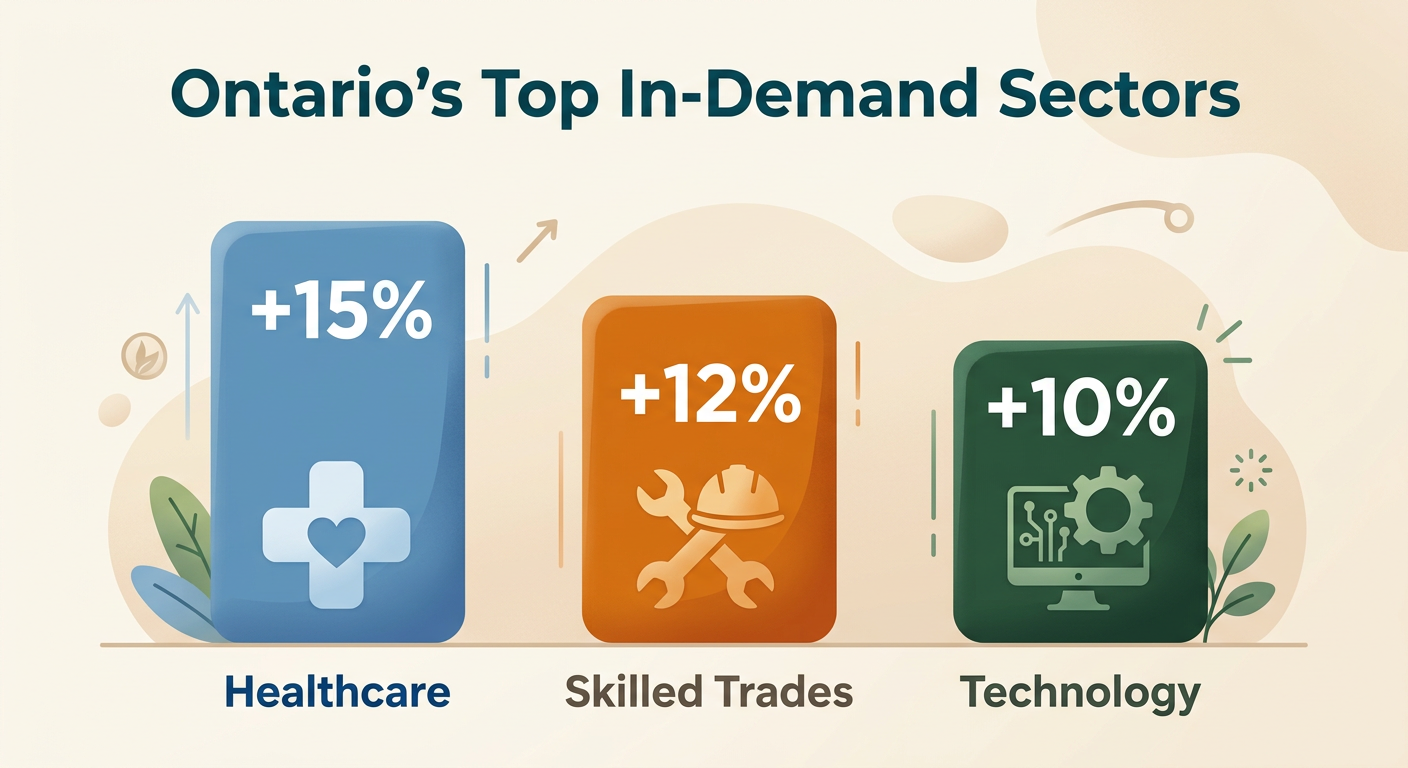
Here’s why this matters more right now than at any point in the last twenty years. Ontario is staring down a structural labour shortage that isn’t going anywhere. The province predicts it will need over 400,000 skilled tradespeople in the next decade just to replace retiring workers — and roughly 50 to 60 percent of the current skilled trades workforce is expected to age out within five to ten years. At the same time, billions of dollars in infrastructure spending — EV battery plants, hospital expansions, nuclear refurbishment, the Ring of Fire mining development — are creating demand that the labour supply cannot meet. These are not cyclical job openings. They are structural vacancies that will exist for years regardless of what the economy does.
The sectors with the strongest and most persistent demand across Ontario right now: healthcare (especially PSWs and nursing — every single region lists them), skilled trades (electricians, welders, HVAC technicians, millwrights), technology (cybersecurity analysts, software developers, data analysts), and transportation (truck drivers, logistics coordinators). These aren’t “maybe” careers. Employers in these fields are competing for graduates — not the other way around.
And here’s the detail that changes everything for someone who doesn’t have four years to spend in a classroom: most of these careers require 6 to 18 months of training at a career college or through an apprenticeship pathway — not a university degree.
Why Most People Pick the Wrong Program — and How to Pick the Right One
I’ve watched this mistake happen enough times that it now feels almost predictable. Here’s how it goes: someone decides they’re “finally going to do something” about their career. They get excited. They browse college websites. They find a program that sounds interesting — “I’ve always loved photography” or “business sounds practical” — and they enrol. A year later, they graduate, start applying for jobs, and discover that nobody is hiring for what they just trained for. Now they have a certificate, debt, and a feeling that they wasted a year of their life.
I once worked with a student who had done exactly this. He had completed a diploma in a creative field, spent nearly $12,000, and discovered there were exactly three job postings in his entire region — all of them requiring five years of experience he didn’t have. When he came to me afterward, the frustration was so thick in his voice I can still hear it. He said, “I feel like I did everything I was supposed to do, and the system just let me walk into a wall. Nobody stopped me. Nobody said, ‘Hey, check if anyone is actually hiring for this first.'”
Here’s the approach that actually works, and it’s the one I now use with everyone: pick the job first, then work backwards to the shortest legitimate program that leads to that job. Go to Job Bank. Find an occupation with a 3-star or better outlook in your region. Note the exact job title employers are posting. Then — and only then — look for a college program whose graduates get hired for that specific role. Match the job title from Job Bank to the career outcome listed in the program brochure. If they don’t match nearly word-for-word, you’re looking at the wrong program.
This sounds obvious when I write it out. But almost nobody does it. College marketing materials are designed to sell programs — they are not designed to tell you whether those programs lead to employment. The responsibility to verify is yours.
One more thing I’ve learned the hard way: not all career colleges are legitimate. I’ve written a complete guide on verifying OSAP-approved schools that I make every student read before they commit to anything. The short version: verify the school is on Ontario’s registered private career college list AND the specific program is on the OSAP-approved program list. Never take the school’s word for either.
How to Get Trained Without Going Into Debt (With a Real Example)
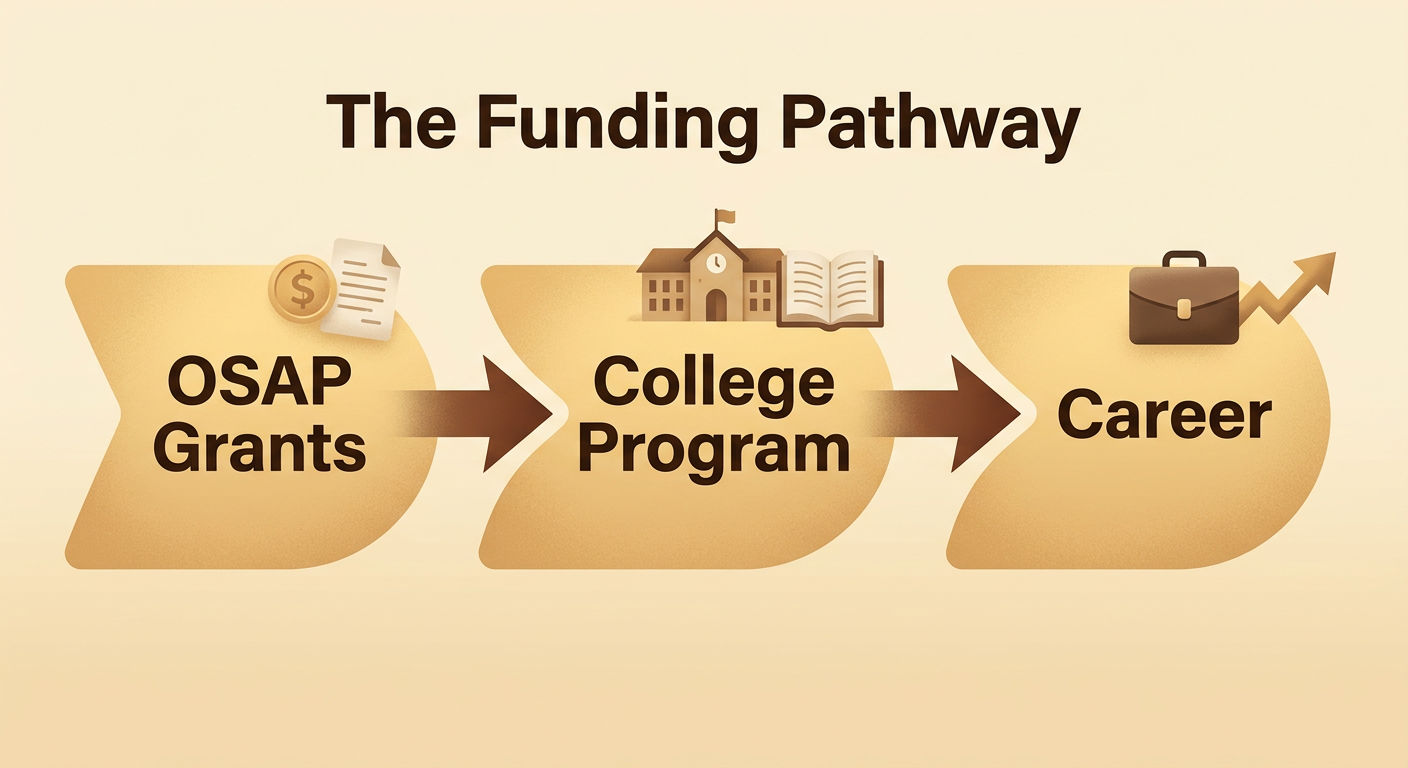
Here’s the part that changes the calculation for almost everyone I talk to: the training for these in-demand careers can be funded almost entirely through grants — money you never pay back. I know that can sound like a sales pitch, so let me give you a real example with real numbers.
Maria is a single mom of two. She was working part-time at a grocery store, had been unemployed for stretches, and wanted to become a PSW. Here’s what her funding looked like:
Better Jobs Ontario (the program I covered in detail in my OSAP and BJO qualification guide) covered $14,500 — her full tuition plus a laptop allowance and transportation costs. OSAP added another $6,200 in grants — the Canada Student Grant for Full-Time Students with Dependants and Ontario grants stacked together. Her total non-repayable package: $20,700. She also received separate childcare funding that paid for her kids’ daycare while she was in class.
Maria graduated nine months later with zero debt and had three job offers before her final clinical placement ended. Was the paperwork easy? No. Her Better Jobs Ontario intake appointment took three weeks to schedule, and OSAP initially undercounted her dependant grant and offered her only $4,200 instead of $6,200. We had to submit a correction. But the money was there — it just needed someone who knew which fields to check and which follow-up phone calls to make.
Maria’s story isn’t unusual. I see versions of it every few weeks. A low-income single parent can receive up to $865 per week through OSAP, with the grant portion often exceeding 60% of the total package. The Canada Student Grant for Full-Time Students with Dependants adds up to $280 per month per child. The Better Jobs Ontario program provides up to $28,000 for programs under 52 weeks or $35,000 for programs up to two years — entirely as a non-repayable grant.
But — and this is where I get honest with every student — none of this money finds you automatically. The forms are confusing. The dependent declaration fields are worded in a way that’s easy to misinterpret, especially if English isn’t your first language. The OSAP Aid Estimator can give you a number that’s thousands of dollars lower than what you’ll actually receive if you apply correctly and appeal when needed. One missed field can cost you thousands in lost grants.
This is not a reason to give up. It’s a reason to not do it alone.
5 Careers Hiring Now — Real Salary Ranges, Real Training Times
Based on verified labour market data and what I’ve personally seen graduates get hired for — not recycled blog lists — here are five in-demand careers in Ontario right now.
1. Personal Support Worker (PSW)
Salary range: $40,000–$55,000/year
Training time: 6–8 months (college certificate plus NACC certificate)
Ontario needs over 50,000 new PSWs by 2031, and the shortage is acute in every region — from Toronto to Thunder Bay. The PSW certificate is OSAP-eligible at career colleges across the province. This is the single fastest path to a guaranteed job in healthcare. Every PSW graduate I’ve worked with has had multiple job offers before graduation. Several have started at the high end of that salary range with overtime and weekend premiums. One woman I helped went from Ontario Works to $52,000 a year in under twelve months.
2. Industrial Electrician
Salary range: $75,000–$105,000/year
Training path: 4-year apprenticeship (paid on-the-job training + classroom blocks). The Red Seal certification is nationally recognized, which means you can work anywhere in Canada. Unlike PSW or truck driving, this path requires you to find an employer sponsor first — the apprenticeship is a job from day one. Ontario’s manufacturing revival, green energy investments, and infrastructure boom are driving demand that consistently outpaces supply. Skills Ontario ranks industrial electricians as the #1 most in-demand trade for 2026.
3. Welder
Salary range: $50,000–$90,000/year (entry to experienced)
Training path: 6–12 month certificate programs available at career colleges, then on-the-job experience and CWB certification for advanced earnings. Canada expects 23,000 new welding positions by 2028. I’ve seen welders get hired directly from their training programs with starting wages around $24/hour — and the ones who pursue specialized certifications (underwater welding, robotic welding) can push past $90,000 within a few years. One client of mine started at $23/hour after an 8-month program and was making $38/hour three years later.
4. Cybersecurity Analyst
Salary range: $70,000–$120,000/year
Training path: IT diploma or degree (1–3 years) plus industry certifications like CompTIA Security+. With a 30% increase in cyberattacks in 2024 alone, demand is growing faster than training programs can produce graduates. This path is longer than the others on this list, but the salary trajectory is steeper — and the work is desk-based, which matters if you’re physically unable to do trades work. For career changers with some computer comfort, this is one of the highest-ROI pivots available.
5. Logistics and Supply Chain Specialist
Salary range: $45,000–$65,000/year
Training time: 10 months (college diploma)
The demand is consistent across every region of Ontario — logistics doesn’t slow down. I’ve had students go from unemployed to fully employed in under two months through this path. The trade-off: it’s physically sedentary and long-haul routes mean time away from home, which is a real factor for single parents. But for someone who needs income fast and doesn’t mind the road, nothing gets you working quicker.
3 Mistakes That Cost People a Year of Their Life (and How I’ve Seen Them Fixed)
Mistake 1: Enrolling Without Verifying the School Is Legitimate
Private career colleges in Ontario are not all equal — and some are outright dangerous. I’ve seen the damage firsthand. Students who paid tuition, started classes, and only then discovered their program wasn’t OSAP-approved or that their certificate wouldn’t be recognized by employers. In the worst cases, schools have closed mid-program, leaving students with debt and no diploma.
The feeling students describe isn’t just anger. It’s humiliation mixed with disbelief. One woman told me, “I told my whole family I was finally going somewhere. I posted about it on Facebook. My kids were so proud. And now I have to tell them the school just disappeared. I feel like an idiot.”
The fix: Verify two things before you pay a dollar or sign anything: (1) the college is on Ontario’s list of registered private career colleges, and (2) the specific program — not just the school — is on the OSAP-approved program list. I’ve written a complete step-by-step guide on verifying OSAP-approved schools here. Never skip this. Never take the school’s word. Verify independently.
Mistake 2: Missing the Dependent Declaration on Your OSAP Application
This is the mistake that costs absolutely nothing to fix — but thousands of dollars if you don’t catch it.
I had a single mother come into my office last winter, holding her phone, staring at her OSAP assessment. “$4,200,” she said. “That’s it. I can’t live on that. I told myself I was finally going to do this and now…” She trailed off. I asked to see her application, and I found the problem in under two minutes. She had checked the box for “dependent children” but skipped the field labelled “other dependants” — because she assumed “other” meant “other people’s children, not my own kids.” That single misinterpreted field had cost her roughly $6,000 in grants.
She wasn’t stupid. The form was ambiguous. The field was poorly labelled. And because nobody walked through it with her before she submitted, she almost walked away from school entirely over a field she didn’t understand.
We submitted a correction that afternoon. Six weeks later, her revised assessment came through: $11,800. She started her program in January.
I’ve written about the most common OSAP application mistakes in detail here — read it before you submit anything. The key takeaway: if you have children, declare them everywhere the form asks. Every dependent-related field. If you’re unsure what a field means, ask someone who knows the system. One misunderstood checkbox can cost you more than the program itself.
Mistake 3: Waiting Too Long — the Window Is Closing
Starting August 1, 2026, OSAP’s grant-to-loan ratio shifts dramatically — from roughly 85% grants to 25% grants. A student who would receive $17,000 in non-repayable grants today would get roughly $5,000 in grants under the new formula, with the remaining $12,000 becoming repayable debt.
I had a student who came to me in October 2025, trying to decide between starting a PSW program in January 2026 or “waiting until next September when the kids are settled in school.” She was leaning toward waiting. September felt safer. More time to save up. More time to think.
I showed her the numbers side by side. Starting January 2026 meant locking in under the current OSAP formula — where grants make up roughly 85% of provincial aid. Waiting until September 2026 meant entering under the new formula, where grants drop to 25% and the rest becomes a repayable loan. For her situation — single mom, low income, two kids — the difference was roughly $13,700 in grants versus about $3,400. Over ten thousand dollars that she would either receive as free money or carry as debt for years.
She started in January. She’s halfway through her program now. She told me last month that if nobody had shown her those two numbers side by side, she would have “done the responsible thing” and waited — and the responsible thing would have cost her over ten thousand dollars.
The window is still open for anyone starting a program with a study period before August 1, 2026. But every week that passes is one week closer to a system where most of your “help” arrives as a loan.
FAQ: The Questions I Get Every Week From Real People
Can I really get trained for free in Ontario?
For many people — yes, especially if you’re low-income, a single parent, or have been unemployed. The combination of OSAP grants (non-repayable), Better Jobs Ontario funding (grants up to $28,000), and college bursaries can cover your entire tuition and contribute to living expenses. Maria’s story above — $20,700 in non-repayable funding — is not unusual. The catch isn’t the money existing. It’s the paperwork — getting the applications completed correctly, claiming every grant you qualify for, and not quitting during the waiting periods. That’s where most people need help.
What if I’m over 40? Am I too old to start over?
The average age of the people I work with is between 35 and 52. You’re not too old — and in many skilled trades and healthcare roles, employers actively prefer mature workers. They show up on time. They don’t quit after three weeks. They have real reasons to succeed. The oldest person I’ve helped start a new career was 61. She’s employed now. She told me afterward that her only regret was “waiting ten years because I thought I was already past the age where this was possible.”
How do I know which career is actually hiring — not just on a list?
Use the Job Bank trend analysis tool at jobbank.gc.ca and look for occupations with a 3-star or higher outlook in your specific Ontario region. A “top careers” list on a blog is someone’s opinion. Job Bank data is government-verified hiring patterns aggregated from actual employer behaviour. Trust the latter. It’s the same tool I use when I’m helping someone decide between two career paths — and I’ve never been burned by a 3-star outlook.
What if I’m a newcomer — do these funding programs apply to me?
Permanent residents and protected persons are eligible for both OSAP and Better Jobs Ontario. International students on study permits are not. If you have a regular Canadian SIN that doesn’t start with a 9, you’re likely eligible. I’ve worked with permanent residents who had been in Canada less than two years and received full funding. Your immigration status doesn’t automatically disqualify you — but you do need someone to check your specific situation, because the rules vary by program and visa type.
Do career college programs actually lead to jobs?
The right ones do — consistently. The wrong ones don’t — and the graduates who come to me afterward are some of the most frustrated people I’ve ever met. The difference between the two comes down to three things: (1) is the occupation in verified demand (Job Bank, 3-star+), (2) is the school legitimate (Ontario registered PCC list and OSAP-approved program list), and (3) does the program’s stated career outcome match the actual job title employers are posting. I’ve seen PSW graduates get hired within weeks of finishing. I’ve also seen graduates of unaccredited “business” programs send out 200 applications with zero responses. The program matters more than the college name. The career matters more than the program.

Final Thoughts — and the One Step That Changes Everything
I’ve spent a lot of time with people who are standing at the exact crossroads you might be at right now — knowing something has to change, having a rough idea of the direction, but terrified of wasting time or money on the wrong move. That fear is not irrational. It’s the most rational thing in the world when you have limited resources, real responsibilities, and no safety net to catch you if you fall.
But here’s what I’ve also seen, over and over, often with people who had every reason to give up: the people who get through to the other side — the single moms who become PSWs, the laid-off factory workers who become electricians, the newcomers who find their footing in a Canadian career — they’re not the ones with the cleanest paperwork or the most straightforward life histories. They’re the ones who didn’t let the complexity, the waiting, or the self-doubt convince them the answer was no before they’d even gotten one.
The funding exists. The programs exist. The jobs are hiring — and they will keep hiring for years because the labour shortage is structural, not cyclical. The gap between where you are and where you want to be is smaller than it looks.
But navigating it alone is where most people get stuck. The forms. The estimator that lies to you. The dependent field that steals $6,000 because of a labelling choice. The Employment Ontario intake wait. The August 1 deadline. There are real friction points in this system, and they’re designed in a way that weeds out people who don’t have someone helping them.
If you want to know what programs you qualify for, what funding you’d actually receive — not an estimator guess, not another blog post — and whether this makes sense for your specific situation, let’s figure that out. It’s free. It takes one conversation. And you’ll walk away knowing a real number.
We’ve helped single parents who cried in our office because they thought they had no options. We’ve helped laid-off workers who hadn’t written a resume in twenty years. Most of them are working now, in careers they chose because the data said those jobs were hiring — and the data was right.
The next step isn’t filling out a 40-page OSAP application by yourself at midnight, unsure if you’re checking the right boxes. It’s a conversation. Let’s have it.